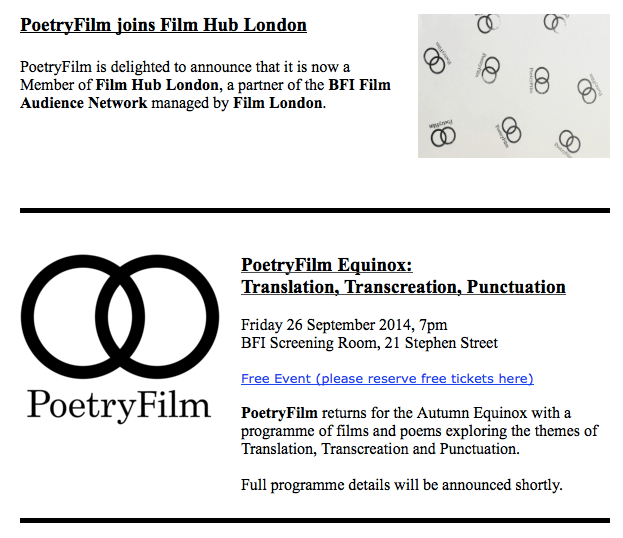
Due to high demand for tickets, PoetryFilm Equinoxwill now take place at Framestore (19-23 Wells Street), not at the BFI Screening Room. Framestore is equidistant between Oxford Circus and Tottenham Court Road tube stations.
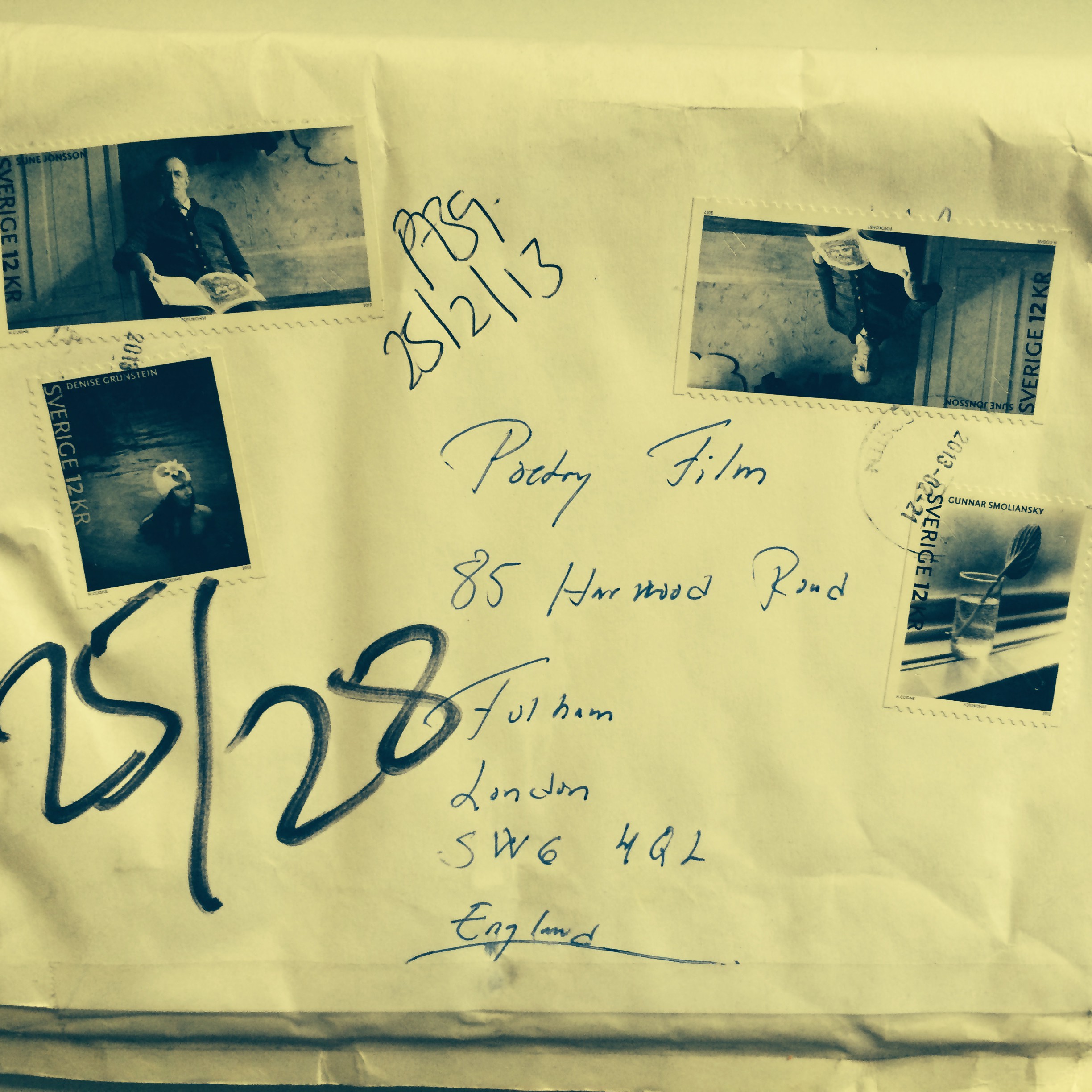
This is one of my favourite envelopes received. It is from Sweden and features four stamps of the important Swedish photographers Sune Jonsson (a documentary photographer and writer), Gunnar Smoliansky (a photographer of the understated), and Denise Grunstein (an ethereal portrait photographer) positioned jauntily.
Moving Words is an exhibit hosted at Illuminations Gallery, the digital-visual exhibition space of the School of English, Media and Theatre Studies at the National University of Ireland in Maynooth, Ireland. The exhibit, curated by Dene Grigar, explores 30 years of net-based kinetic poetry and prose, presenting various artistic approaches and methods of expression, from cinematic animated text displayed originally on a computer screen to highly interactive textual spaces meant for mobile devices. Click here to go to the Moving Words website.
The PoetryFilm Archive is a fully catalogued hard (physical) archive. Selected film stills, photographs, links, images and texts from the collection are featured here in the “PoetryFilm Archive” category.
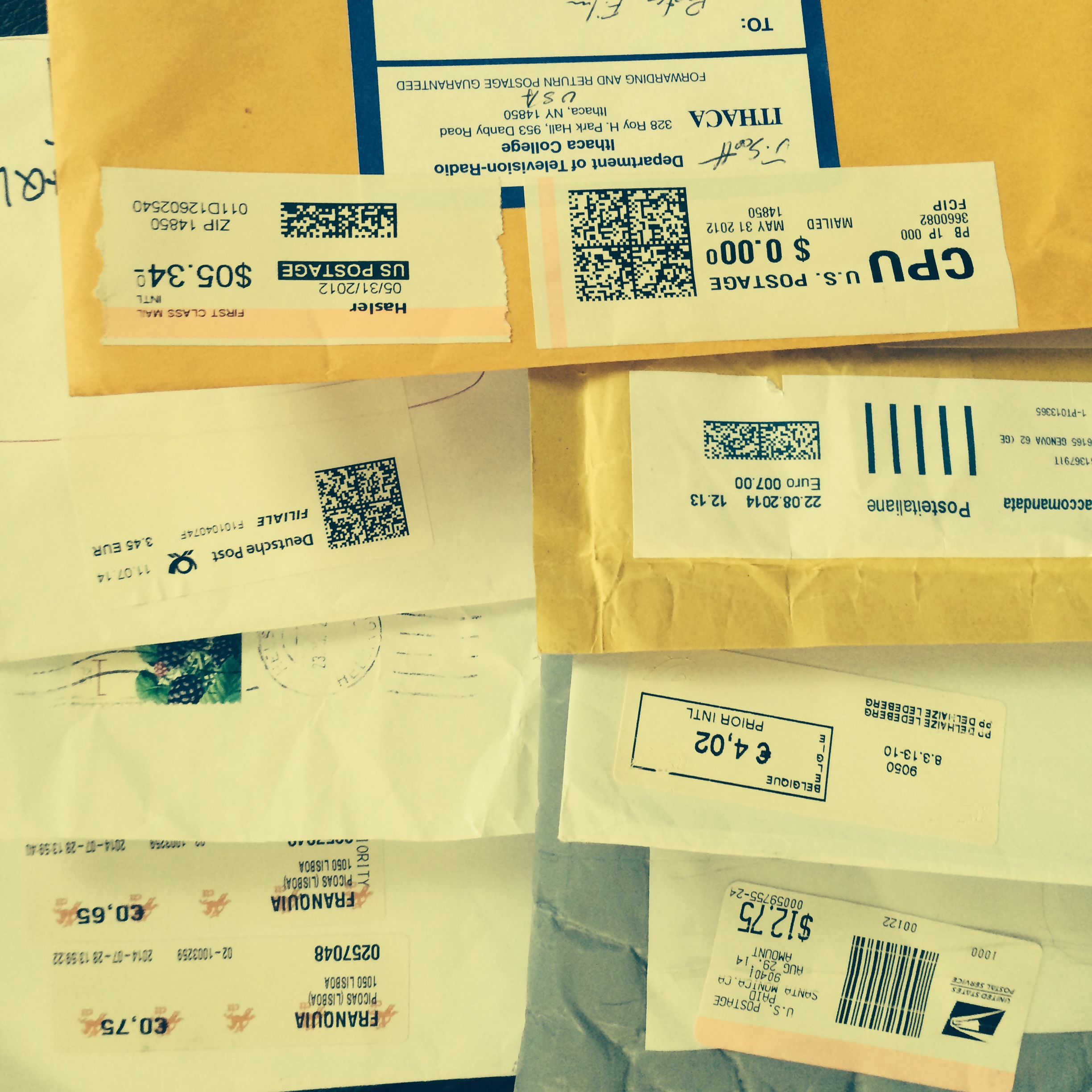
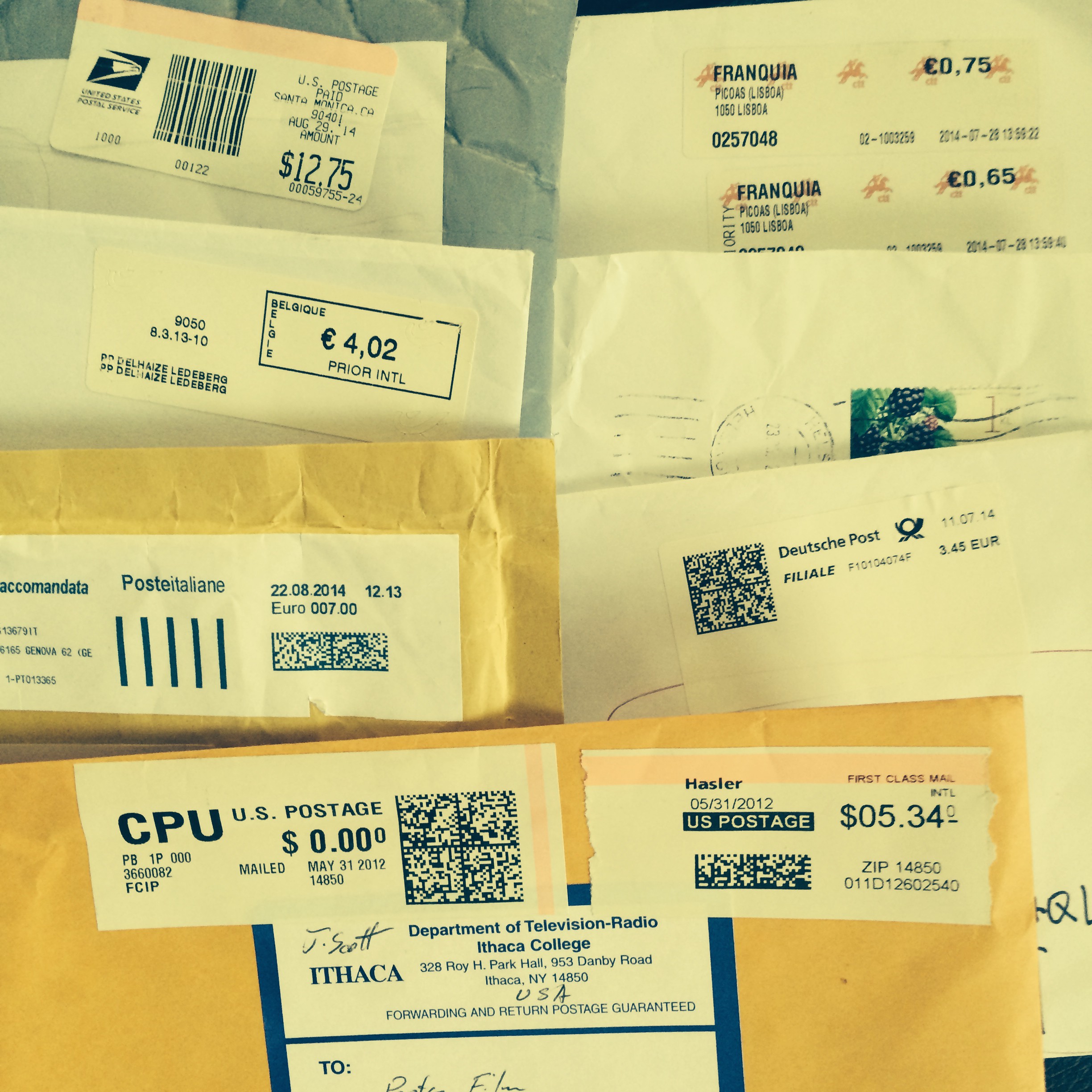
Submissions are invited for a forthcoming series of PoetryFilm events. Work welcome: art films, text films, sound films, silent films, poet-filmmaker collaborations, auteur films, films based on poems, poems based on films, and other experimental text/image/sound screening or performance material. Please send hard copies of material in the post.
Dream Poem is in the PoetryFilm Archive and has been screened at a number of events. It was first screened at the PoetryFilm event at Tate Britain in April 2006, where Zata curated a programme on the theme of Dream.
Director’s Statement:
“In dreams it’s impossible to read the same thing twice and not have it change on you. In 2006 I made this poem from the perspective of someone who is having a fitful night’s sleep and is worried about their relationship, about loneliness, about death. The film was once played for the Sultan of Brunei, whose daughter is dyslexic. He actually sent me a sword to say thank you. It was all very strange. I still love it dearly, so I hope you enjoy it as much as the Sultan did. Please don’t send me any more swords.” – Dann Casswell
Biography: Dann Casswell
Since creating Dream Poem in 2006, Dann Casswell has worked full-time for the BBC on local radio, for BBC Children in Need and organising creative BBC Outreach projects in his home town of Bristol. He has had work published in various short story outlets and has had work commissioned by BBC Radio 4. Dann is now a director of CreativeConnection.co.uk where he works running the animation channel, writing, producing and directing beautiful short films and high-end communications for corporate and charity clients.
Notes
Dream Poem is a valuable example of a text-on-screen poetry film that could never be experienced in this way as written text on paper, or as spoken text. Even if each of the text iterations were transcribed into a sequence of concrete poems, the reader certainly would be able to read the words, but would not have the same experience as watching this ninety-second film.
The structure of Dream Poem alludes to secondary revision in psychoanalysis. “Secondary revision” is the expression Freud uses for the final stage of dream production: after the dreamer undergoes one or more of the four dreamwork processes (displacement, condesnsation, symbolization, projection), the dreamer then undergoes the secondary processes of the ego in which the more bizarre components of the dream are re-organized in order to present the dream with a comprehensible surface meaning. This surface meaning, once arrived at through secondary revision, is the manifest dream.
Part of the experience of watching Dream Poem is that there is not quite enough time to read the full text on the screen. Halfway through reading the text on the screen, that text changes, sometimes with surreal replacement words, like a glitch in the system. The text changes again, and again. The viewer questions whether what was read moments before was actually there. One questions one’s own perception. The word “Switzerland” changes to “Swindon”, for instance. The experience of scrambling to read all the text on the screen before it disappears is very similar to the act of trying to remember a dream that is slipping away upon waking, and perhaps this is frustrating; however, one of Dream Poem’s strengths is that creates within us an experience.
Unknown Woman is in the PoetryFilm Archive and has been screened at a number of events including PoetryFilm at Tate Britain and PoetryFilm at Curzon Soho. The film traces a woman’s psychological journey using a mixture of drawn animation, stop-motion and live-action footage; the film originated from dreams of a woman and a crow in which the two beings shared one sentience.
“The man looks the world full in the face, as if it were made for his uses and fashioned to his liking.
The woman takes a sidelong glance at it, full of subtlety, even of suspicion.”
Orlando, Virginia Woolf, Selected Works of Virginia Woolf p. 490
The below copy is taken from the artist’s website.
PoetryFilm Blackboard was a participatory text/art project devised by Zata Banks. Participants were invited to write or draw on a blackboard using chalk. A photograph was taken of each person’s blackboard and a montage film was made showcasing all the blackboard contributions. PoetryFilm Blackboard was commissioned by the Southbank Centre as part of Poetry International and the Festival of Love on 18, 19, 20 July 2014 and took place at the Saison Poetry Library at the Royal Festival Hall.
During Poetry International (18 – 21 July 2014), the Poetry Library’s exhibition space was turned into a giant page.
Visiting poets from all over the world were asked to contribute a line towards a new collaborative sonnet. The poem grew throughout the festival as lines were added by hand and the poem took its visual form.
The poets were: Kutti Revathi (Tamil), Nikola Madzirov (Macedonia), Ana Blandiana (Romania), Kayombo Chingonyi (Zambia), Rhys Trimble (Wales), Sujata Bhatt (India / USA / Germany), Sabrina Mahfouz (British / Egyptian), Michael Augustin (Germany), Inua Ellams (Nigeria), Tom Warner (England), Maitreyabandhu (England).
The Global Love Poem exhibition at the Saison Poetry Library also included PoetryFilm Blackboard, a participatory text/art project devised by Malgorzata Kitowski. (You can just see the blackboard and the participants on the right hand side of the screen.)
Speech-synthesis and sine-wave speech demonstration video, prepared for the artist project Disinformation, premiered in the PoetryFilm “Sounds of Love” event at the Southbank Centre, London, 19 July 2014.
More information taken from the artist’s website is below.


![Je Suis Ici IMAGE LSFF 09 web[5]](https://poetryfilm.org/wp-content/uploads/2014/08/tmwmh-main-web8.jpg)






























 PoetryFilm