“gap in the air” Festival of Sonic Art at Talbot Rice Gallery
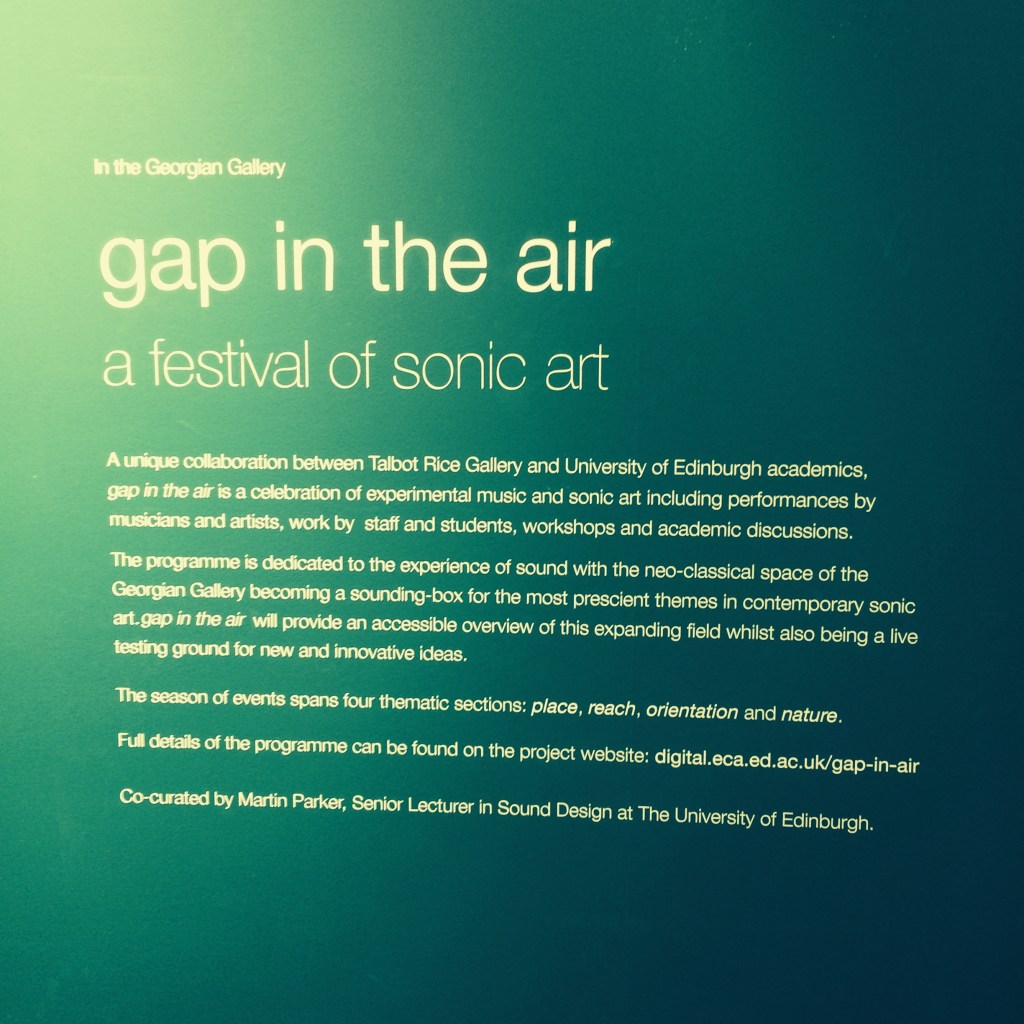

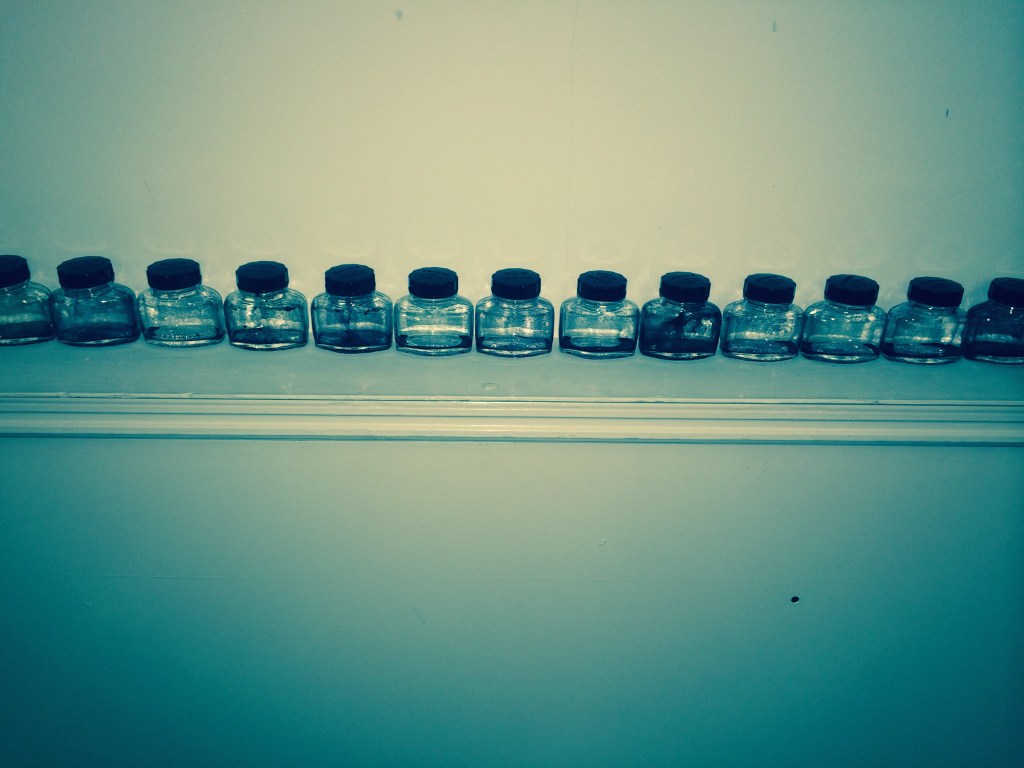
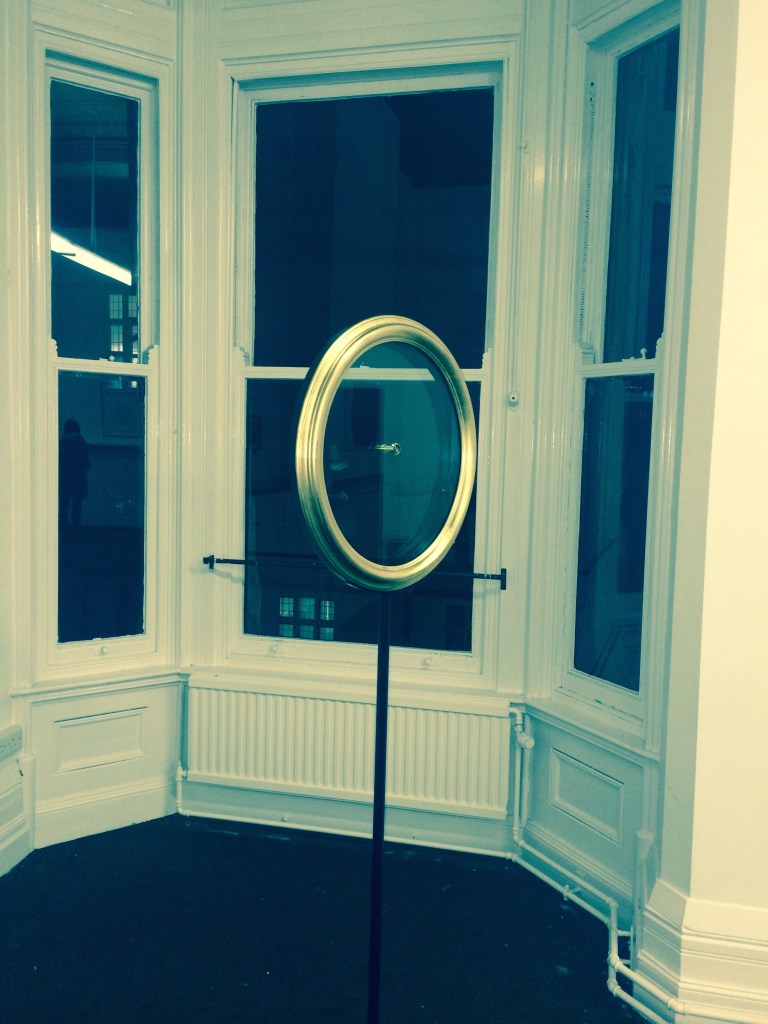
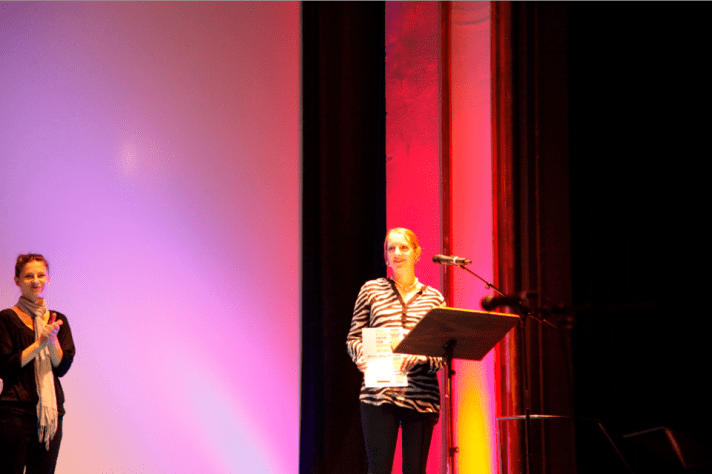
Photograph taken at the launch of Christopher Orr’s show at Talbot Rice Gallery in Edinburgh.
The picture of the painting in the catalogue is nearly exactly to scale.

Travelling to Cork today reminds me of a film about Antonin Artaud I saw last year at the Portobello Cinema called The Door Ajar. Thanks to Niall McDevitt for bringing this valuable film to London.
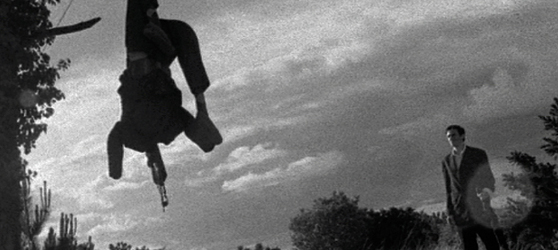
*On August 14th 1937 the French poet and theatre director, Antonin Artaud, arrived in Cobh in County Cork, bringing with him a stick which he believed St. Patrick owned. His intention was to return the staff to its rightful owners and, with their help, to rediscover some fundamental truths.
His journey didn’t turn out exactly as planned and, on September 23rd, he was arrested while trying to gain entrance to a religious house on the outskirts of Dublin. Other than these facts, little record remains of his journey, except for a scant outline of his movements provided by two unpaid bills and some postcards sent from Galway.
The Door Ajar examines Artaud’s back-catalogue of poems, letters and essays and uses them to create a possible account of the weeks he spent travelling in Ireland, revealing a fascinating portrait of a man hell-bent on a search for truth and driven by a longing to penetrate to the very core of existence. The unmistakable rigour and style of Paddy Jolley’s art brings Artaud’s journey to life – and his brilliant new film will inspire and enthral fellow filmmakers and audiences alike.
Director: Paddy Jolley
Producer: Edwina Forkin
*Text by Gráinne Humphreys, Jameson Dublin International Film Festival
PoetryFilm heads to Cork today in advance of the O’Bheal Winter Warmer Festival, 21-22 November. Festival documentation will be posted here shortly.
Bob Jubilé is a year-long programme of displays and events devoted to the career and legacy of Bob Cobbing, curated by William Cobbing and Rosie Cooper.*
Bob Cobbing (1920-2002) was ‘the major exponent of concrete, visual and sound poetry in Britain’ (Robert Sheppard, The Guardian). His performances of printed sound poems involved stretching language through the deployment of shouts, hisses, groans, interspersed between more recognisable tracts of spoken word.
Bill Jubobe
Chelsea Space
19 November – 19 December
16 John Islip Street, SW1P 4JU
11am – 5pm Wednesday-Friday
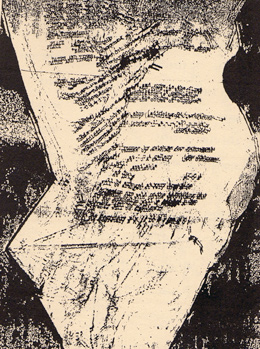
no.w.here presents Frenkel Defects. Wednesday 19th November 2014, no.w.here, third floor, 316 – 318 Bethnal Green Road, London E2 0AG. 7pm start.
Frenkel Defects* is a programme of hand made 16mm films from artists working in DIY labs worldwide. These works have been curated by Kevin Rice from Process Reversal a lab collective based in Colorado USA. Photosensitive film material is formed of a multitude of silver halide crystals, suspended in gelatine, without which we would not be able to record a latent negative image. A Frenkel Defect is a fault within the silver crystal structure of the film emulsion. 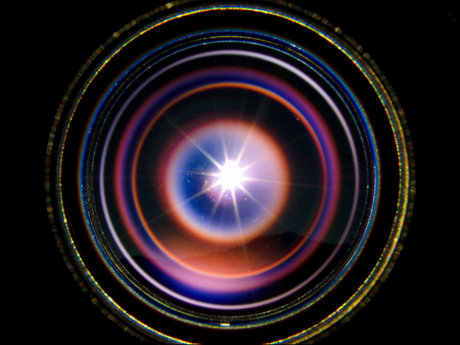 Image by Andrew Busti
The most interesting aspect of a Frenkel Defect (at least in the vein of this program) is not specifically its photo-mechanical properties, but the implication that film must be imperfect to function. In this sense, the silver halide might also be seen as a reflection of our films and ourselves, both which, arguably, necessitate a mode of imperfection. Further, we might also consider that projection is a form of photography, one whereby we, the audience, are the photosensitive material – full of defects – that is allowed to be imprinted with a latent image. The full programme can be viewed here. *Text taken from no.w.here
Nov 19
The recent comments by Nicky Morgan, the Education Secretary, brought to mind Sir Ken Robinson’s well-known TED Talk in which he makes a case for creating an education system that nurtures and encourages creativity.
The full transcript of the talk is below (with timings).
Some photographs from the Regulate launch at the Montgomery in Sheffield on Friday 7 November. Many thanks to Dora and the Regulate Team.

Below are photographs from the Prize Giving for the Shot Through the Heart poetry film competition (Purcell Room, Southbank Centre, July 2014). Congratulations to Ella Jane Chappell and Katie Garrett for the winning film Rolling Frames. Thanks to Rachel Cherry and Southbank Centre for the photographs.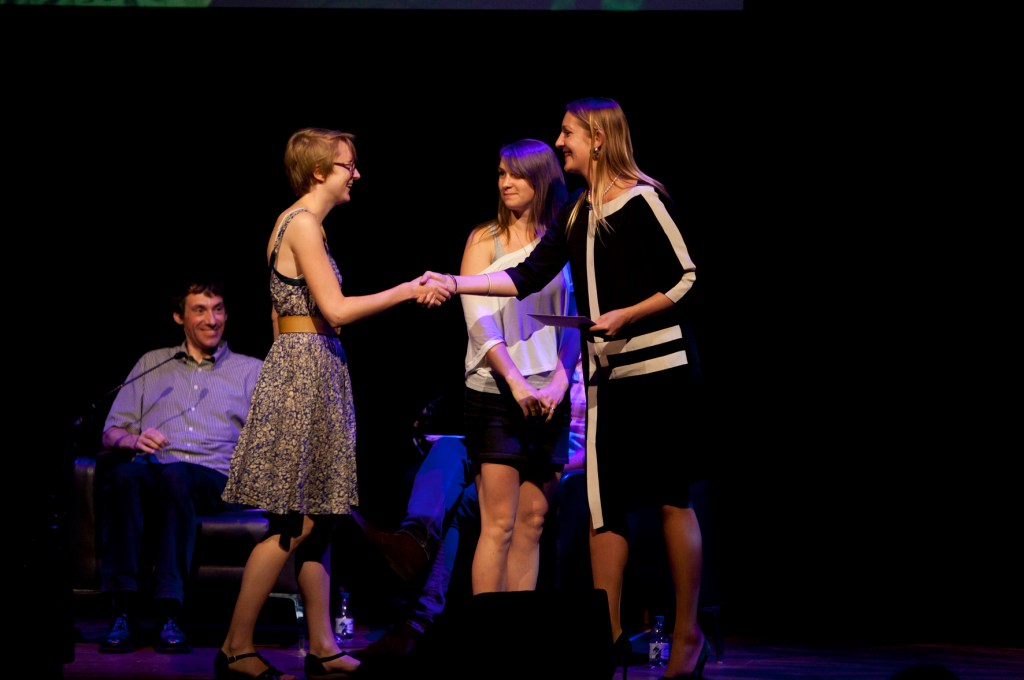
“Rook & Raven are proud to present Abstract Geometry, an exhibition inspired by the development of the Fibonacci sequence in visual culture. Informing each featured artist’s work, the sequence appears in various manifestations, constant throughout, in a manner paradigmatic of Leonardo Fibonacci’s theorem, published in his 1202 landmark text, Liber Abaci. The text recounts the correlation between geometry and nature, leading to a shift in artistic practice, still evident today, in its similar link to the Golden Section, historically used by many artists as a visual tool.
‘Line is the sole element of construction and creations… Line is trajectory, movement, collision, attachment, slicing apart, joining. Line is first and last in both painting and in any construction whatsoever.’
(A. Rodchenko, The Line (1921), translated in Art Into Life: Russian Constructivism 1914-1932, Seattle 1990, pp.72-3.)
Bringing together the work of Vanessa Jackson, Rupert Newman and Vanessa Hodgkinson, whose works are concerned with the use of shape, colour and composition, and the sequences and relationship between such properties, Abstract Geometry is the result of the interrelation of mathematics, nature and art, focusing on how the past is present in contemporary abstract art.”
The full Press Release is here: ABSTRACT-GEOMETRY1
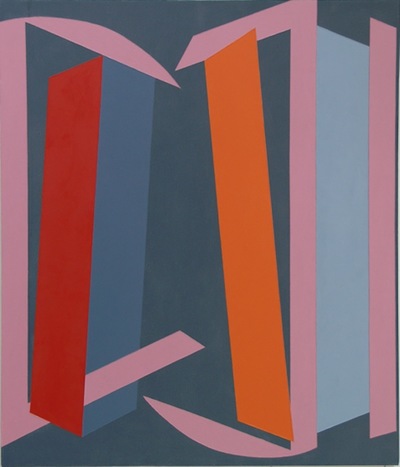
Fling by Vanessa Jackson
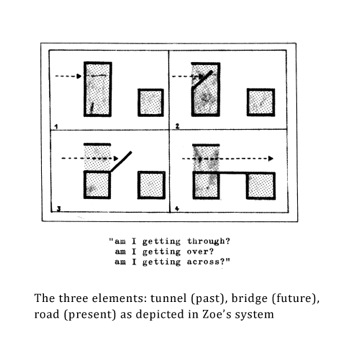
“In this new radio drama from Peter Blegvad and Iain Chambers, the transformative power of storytelling is explored through Zoe, a psychiatric patient who believes she is the Queen of Time. Zoe is confident that her map-like drawings can evoke the ‘eternal moment,’ in which she’ll be set free of time itself. She also believes Cody, her art therapist, is the other half of her divided self – the King of Time.
Radiotonic proudly presents The Eternal Moment in conjunction with ABC-wide programming in support of Mental Health Week.” (ABC = Australian Broadcasting Company)
http://www.abc.net.au/radionational/programs/radiotonic/the-eternal-moment/5782860
The PoetryFilm Solstice event will take place on Sunday 21 December at 3pm at the ICA Cinema in London.
Tickets will go on sale in mid-November and full programme details will be announced shortly.
Yesterday I attended this fascinating and engaging lecture given by John Woodward. Many thanks to the University of Westminster for the invitation to attend.
Speaker biography: In his career, which includes top leadership roles at the British Film Institute, the UK Film Council, and, currently, Arts Alliance, John has played a key role in the re-birth of the British film industry and he has also overseen millions of pounds worth of investment into British films such as The King’s Speech.
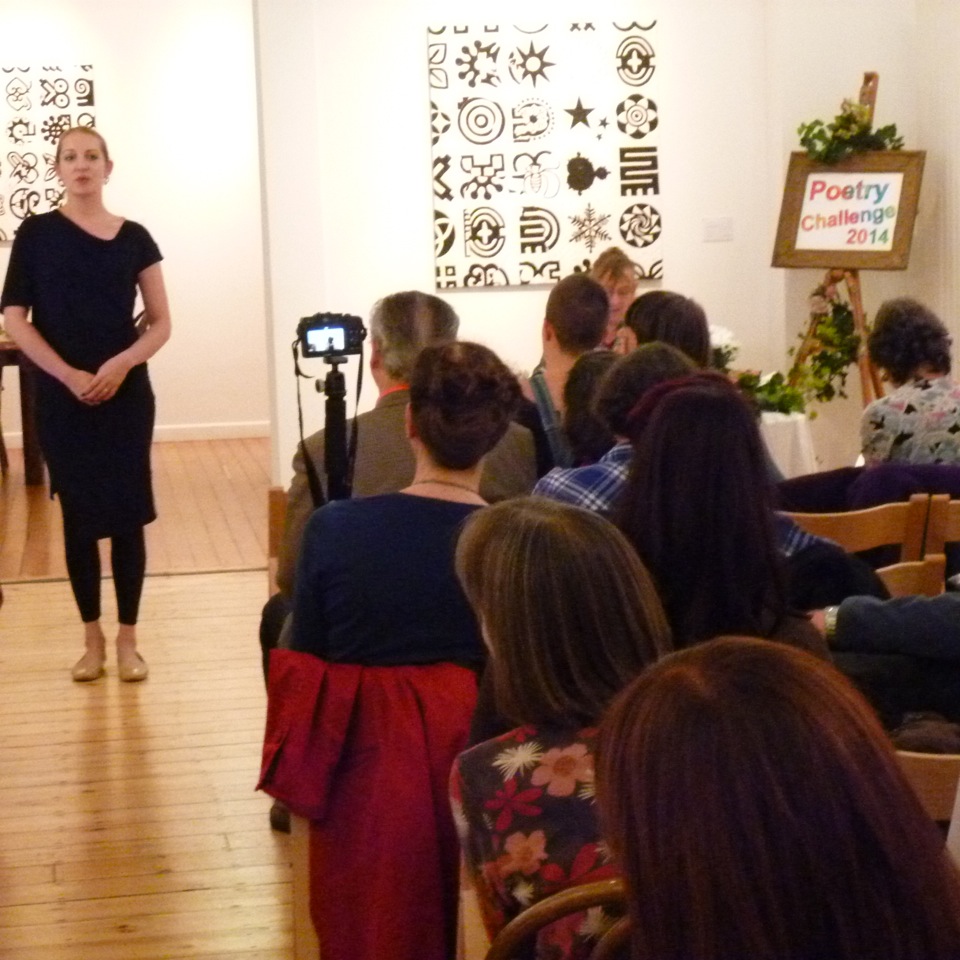
Zata Kitowski performing at the Poetry Challenge recitational fundraiser at the October Gallery in October 2014. Zata recited her poem Ampersand. Many thanks to Josefine Speyer for the invitation and photograph. My nominated charity was the British Heart Foundation.
PoetryFilm has been awarded a Trademark Registration Certificate by the Intellectual Property Office.
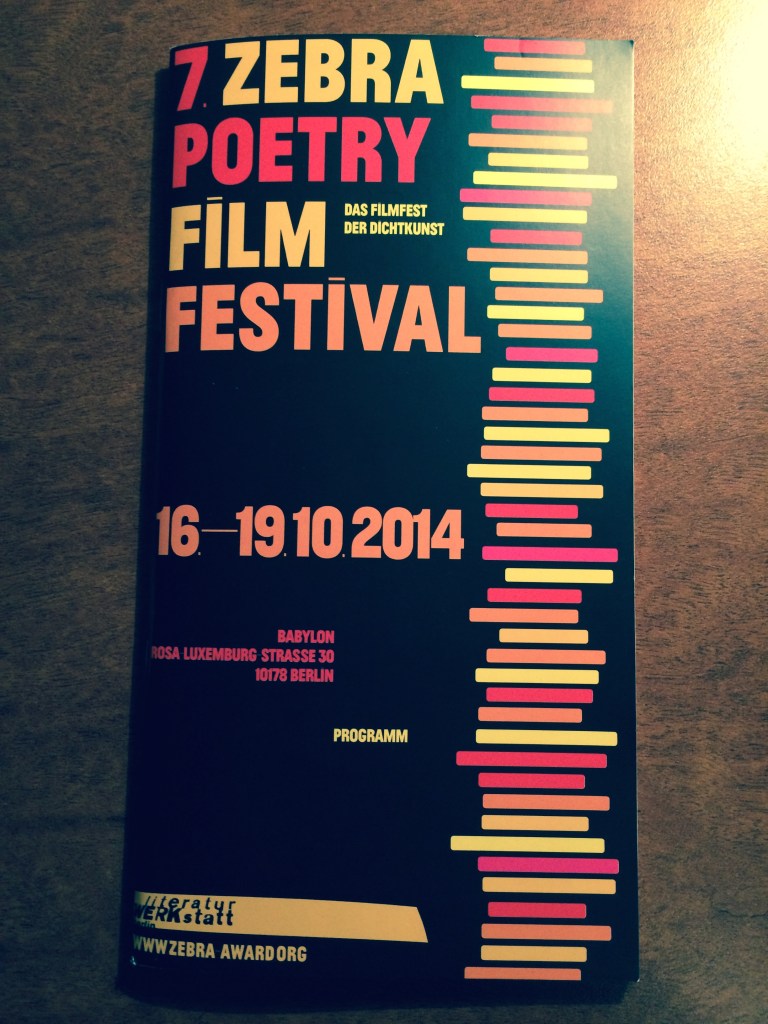
It has been a busy month of film festivals and I enjoyed both the BFI Film Festival (in London) and the Zebra Poetry Film (in Berlin).

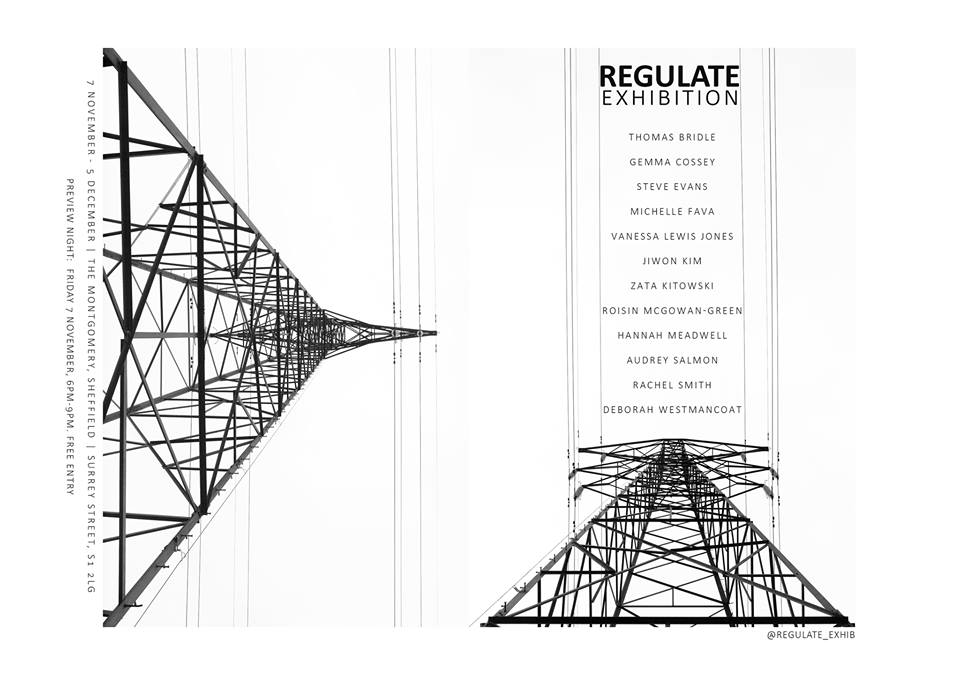
Regulate is an exhibition showcasing recent works by 12 artists who responded to the theme of routine and repetition in contemporary art:

Thomas Bridle, Gemma Cossey, Steve Evans, Michelle Fava, Vanessa Lewis Jones, Jiwon Kim, Zata Kitowski, Roisin Mcgowan-Green, Hannah Meadwell, Audrey Salmon, Rachel Smith, Deborah Westmancoat, Gemma Cossey
Throughout the evening, artist Rachel Smith will produce durational drawings, creatively documenting the event. Overheard conversations from the evening with be used to create drawings – the words will visually merge to document overlapping and truncated narratives from the noise and dialogue around the exhibition.
Friday 7 November, 6-9pm.
Free entry.
Oct 22
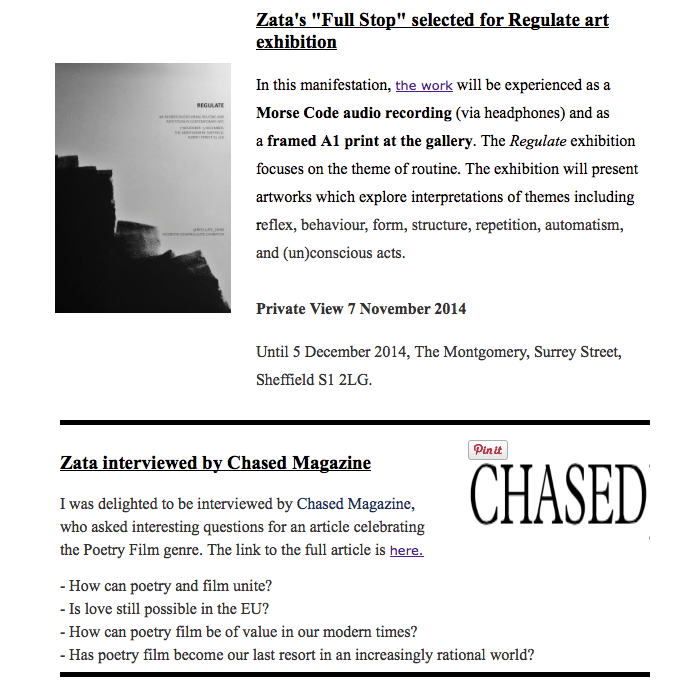
I am delighted to hear that Full Stop has been selected for the forthcoming Regulate art exhibition. In this manifestation, the work will be experienced as a Morse Code audio recording (via headphones) and as a framed A1 hanging print at the gallery.
The Regulate exhibition is on the theme of routine. The exhibition will explore behavioural, visual and customary elements and present two dimensional works discussing a broad range of artistic interpretations of the habitual and optical pattern.
Key words: reflex, behaviour, form, structure, repetition, automatism, (un)conscious acts.
Regulate will be held from 7 November-5 December 2014 at The Montgomery, a multi-purpose space based in the heart of Sheffield City Centre. Various creative events and workshops will be held in the space during the exhibition.
Words & voice by Øyvind Rimbereid
Organ by Nils Henrik Asheim
Design & animation by Kristian P.
—
The Pipes (Norwegian: Pipene)
Written for the opening of the Stavanger Concert hall and its custom built organ, The Pipes is an ode to industrial history – the former backbone of the city’s economic and social life.
Read more
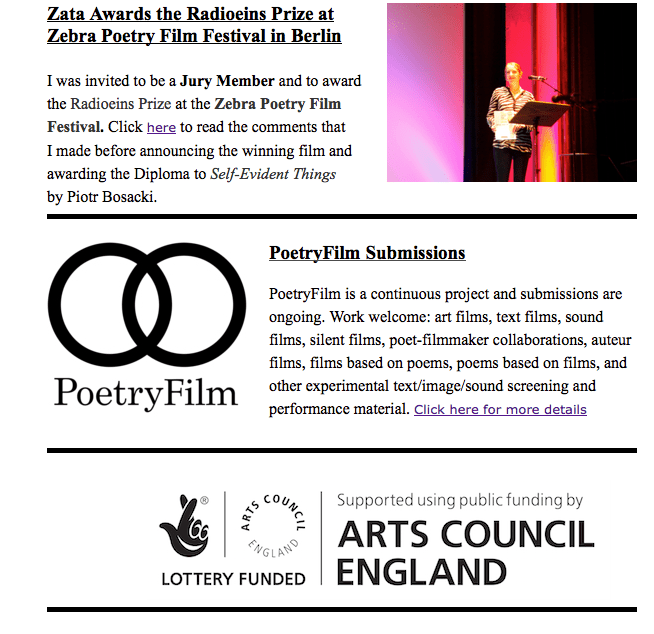
I was delighted to be invited to be a Jury Member and invited to award the Radioeins Prize at the Zebra Poetry Film Festival. Below are the comments I made before announcing the winning film and awarding the Diploma to Self-Evident Things by Piotr Bosacki.
The film was chosen on the basis of a majority vote by the audience jury team and the film was chosen for a number of reasons:
 Zata Kitowski awarding the Radioneins Prize Diploma. It was received by Boris Nitzsche from Literaturwerkstatt Berlin on behalf of Piotr Bosacki.
 Film still from Self-Evident Things / Rzeczy Oczywiste by Piotr Bosacki.
The winners of the 7th ZEBRA Poetry Film Festival have been announced. Congratulations to:
La’eb Al Nard / The Dice Player
Film: Nissmah Roshdy – Egypt 2013, 3 min
Poem: La’eb Al Nard by Mahmoud Darwish
Pipene / The Pipes
Film: Kristian Pedersen – Norway 2014, 3 min
Poem: Pipene by Øyvind Rimbereid
essen – stück mit aufblick
Film: Peter Böving – Germany 2013, 10 min
Poem: essen – stück mit aufblick by Ernst Jandl
The Aegean or the Anus of Death
Film: Eleni Gioti – Greece 2014, 7:30 min
Poem: The Aegean or the Anus of Death by Jazra Khaleed
The ZEBRINO prize for the Best Poetry Film for Children and Young People was won by:
Death for a Unicorn
Film: Riccardo Bernasconi, Francesca Reverdito – Switzerland 2013 15:00 min
Poem: Death for a Unicorn by Francesca Reverdito
The radioeins Audience Prize, awarded by a jury of radioeins listeners, has gone to:
Rzeczy oczywiste / Self-evident Things
Film: Piotr Bosacki – Poland 2013, 10 min
Poem: Rzeczy oczywiste by Piotr Bosacki
Faux Amis by Érik Bullot was shown at PoetryFilm Equinox in September 2014. Another of his films, Tongue Twisters, is also in the PoetryFilm Archive. Below is an insightful interview with Érik Bullot* about language, sound and cinema.
In your artistic research, language and voice seem to be central themes. When and how did this interest start?
I have been always interested by the issue of language, especially the topic of imaginary languages. As you know, the medium of film was originally imagined as an universal language or esperanto. It was a political dream. When I began making films, I made many silent films with the purpose to get a visual language. During my first film made in video, I was very struck by the relationships between video and writing. I think there is a continuity between these different mediums. Video is a kind of writing machine. I made a first film, Speaking in Tongues (2005), based on imaginary languages. It was the first step of a series of films about translation, misunderstandings and puns: Tongue Twisters (2011), about tongue twisters, shot in Berkeley; Faux amis(2012), a film about false friends between French and English, shot in Buffalo; Geographical Fugue (2013), based on a musical piece by Ernst Toch; The Alphabet Revolution (2014), a documentary about the change of alphabet in Turkey. There are always many languages in my film. I like to use linguistic elements as plastic material likely to be deformed, transformed, translated. My dream is making slapstick films with language.
You mainly work with visual media, such as video, photographs, texts and performances. What are your artistic references for what regards sound?
I am interested by artists which work is located between visual and sound fields. I was very impressed for example by the blind avantgarde film made by the German artist and filmmaker Walther Ruttmann, Weekend: a black screen with just a sound piece on the soundtrack. I like very much the works of Cage (Roaratorio) and Kagel (his film Ludwig van) and the experimental filmmakers who work on multilingualism as Peter Rose, Werner Nekes or Michael Snow. I have also a strong interest for the linguistic dimension of slapstick tradition, especially the films of Marx Brothers where you can see a ventriloguist situation between the three brothers.
I was delighted to be interviewed by Chased Magazine for an article celebrating the poetry film artform in the light of the forthcoming Zebra Festival in Berlin. The full article can be viewed here.
Zata Kitowski, a British artist and founder of PoetryFilm
1. How can poetry and film unite?
Both poetry and film either describe experiences, or are experiences in themselves, so in that sense they’re already united… there are poetic aspects to most films, and, equally, poetry uses techniques adapted from cinema such as jump-cut editing and montage, etc. The greatest potential in this context lies in using the Poetry Film concept as a point of focus for exploring and amplifying certain aspects.
2. Has poetry film become our last resort in an increasingly rational world?
A rational thought process is quite useful when crossing a road! It’s been argued that new languages emerge when there is some form of information overload, and poetry films offer opportunities for creating expressions, and communicating messages and meanings in new ways. We’re not yet in a position to assess whether poetry film is our “last” resort; we will be able to judge this at some point in the future, and maybe poetry film will be shown to have been the beginning of a movement.
3. How can poetry film be of value to us in our modern times?
Poetry films open up new ways of engagement, new audiences, and new means of self-expression, and provide rich potential for exploring the creation and perception of emotion and meaning. This in turn enables us to connect with and communicate with people in hopefully innovative ways.
4. Is love still possible in the EU?
Yes, of course.
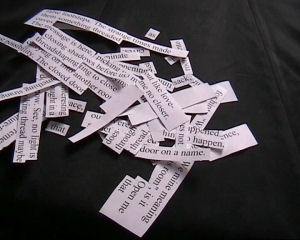
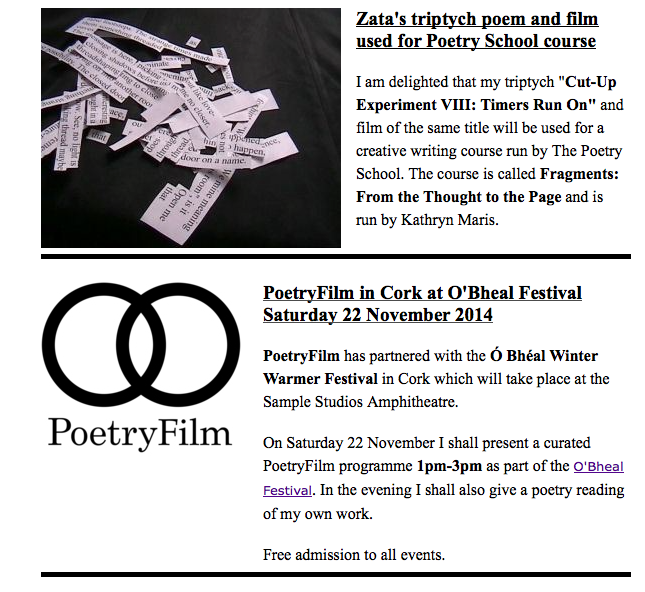
I am delighted that my triptych cut-up poem Cut-Up Experiment VIII: Timers Run On and the associated poetryfilm of the same title will be used for a creative writing course run by The Poetry School. The course is called Fragments: From the Thought to the Page and it is run by Kathryn Maris.
“In this genre-bending course, you will look at poets, fiction writers, philosophers and psychoanalysts who think and write in fragments, use modes of interruption or whose work simply survives in fragment form. Fortnightly reading and writing assignments will aim to broaden your ideas of what is and isn’t a poem, demonstrate the value of omission and the unstated, and suggest new ways of observing yourself and the world, and of communicating those observations. The course will include texts by Sappho, Lydia Davis, Kimiko Hahn, Simone Weil, Adam Phillips, Wallace Stevens, Theodor Adorno, Gertrude Stein, Sam Riviere, Nuar Alsadir, Simon Smith, Anne Carson and others.”
Oct 14
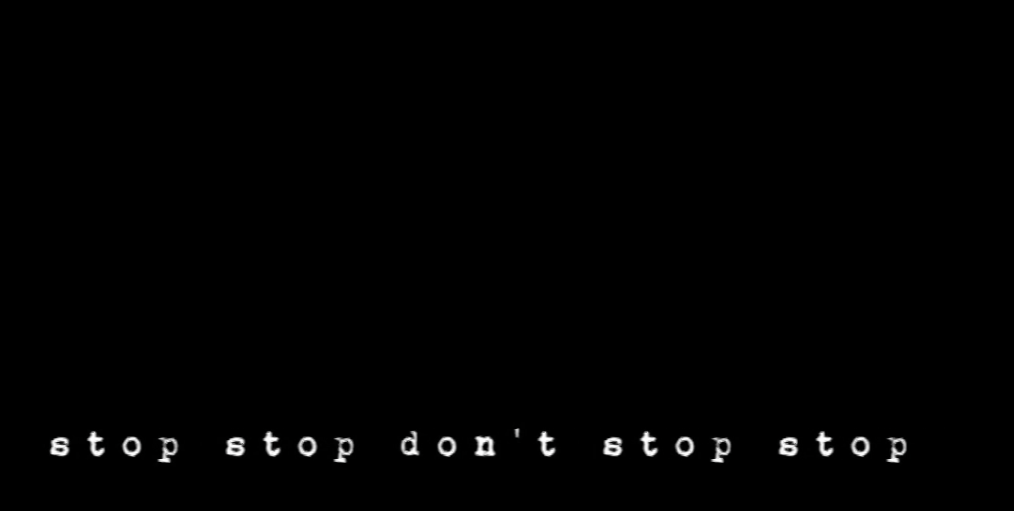
Click to watch Full Stop. The poem (from a sequence of “punctuation poems” published in Doppelgängers in 2005) is transcreated and presented aurally as Morse Code and visually as a moving telegram. (4 minutes, sound).











 PoetryFilm
